Everyone knows the story where the horse was lost for want of a nail, … the courier, … the battle, … the country. But what does this have to do with loosening? A few years ago, we set up a cultivator in a harsher part of the country. It wasn’t particularly pleasant, as the safety springs kept moving, with something roughly hitting the blades in the soil. That season, we worked in other rock-hard fields, but the machine didn’t behave like this. Upon inspection, we found that in the properly stubble-tilled area, there were huge, half-meter solid clods just below the surface. These were gently embedded in a looser layer, so when the cultivator tools hit them, instead of splitting, they started to roll, lifting the machine.
After some inquiries, it turned out that these clods were not freshly formed; the area had been deeply cultivated about a year ago, so these clods were under the plants during the previous growing season. I must say, they remained because we carved them in such a dry state, but we didn’t eliminate them.
Our conclusion is that these clods were formed during the previous loosening due to the improper choice of loosener. And like the unnailed horseshoe, the poorly executed loosening left its mark on the subsequent period.
The problem lies with the popular forward-leaning blade loosener, also known as a chisel plow. The advantage of curved-back or forward-leaning blade loosers is that they have lower draft resistance, as the clods cracked by the tip can gently roll up the tool. Unfortunately, these rolled-out clods become permanent guests in compact dry soil, and it is very difficult to eliminate them afterward.
The solution is not to create large clods, so you don’t have to break them up. Obviously, it’s easy to play from the sidelines, but there’s a logical practice to this. Firstly, clod size is always proportional to the working depth. If we achieve the desired depth in two passes, we are likely to work with clods half the size. It takes more time, of course, and we pay for the tractor’s self-propulsion twice, but if we save on subsequent finishing, it doesn’t look so bad, does it?
Secondly, you need to use a loosener suitable for the soil. A straight-blade loosener is a few percent harder to pull because the clods split by the tip are hit by the straight back like a cutting edge, further breaking them up. We don’t roll out the clods, the surface is even, so instead of a spiked roller, a wedge ring roller is more practical.
Sure, but everyone uses this. Not everyone can be wrong. Firstly, it’s not such a big problem on lighter soils, and secondly, the key lies in the technology. These tools originated from Italy, or rather, everyone licenses them from there, so they are all the same.
The technological twist is that they work on smaller areas there, typically with many driven tools. They keep crumbling until it’s good. However, the structure of Hungarian farms does not allow for this technology.
If we look overseas, the use of straight-back loosers is more common. In farms of several thousand hectares, efficiency is just as important as it is in our country.
Moreover, farmers there take it a step further against short-term logic. We know that in-line arrangement has greater resistance. However, in proper soil conditions, the blades attack the soil simultaneously, lift it simultaneously, and passing between the two backs, they crack it, leaving even less chance for large clods to remain. Emphasizing proper soil conditions is important, as this can cause problems in wetter soil.
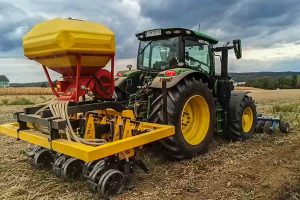
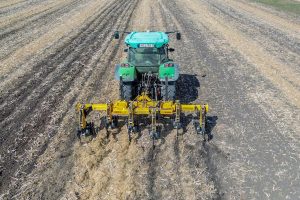
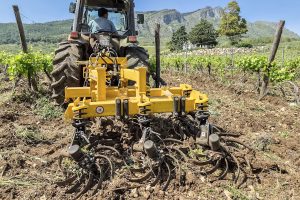
Combining these experiences, Busa Bt developed a spatially adjustable subsoiler, which won the Hungarian Agricultural Machine of the Year award. In addition to several minor improvements, the straight-back subsoiler received a tool holder that allows the arrangement of the subsoiler blades to be reconfigured. Thus, the machine can be used as a two-row, depth-segmented subsoiler, or in dry conditions, it can be reconfigured to an in-line arrangement. If a mulch-leaving or minimal tillage technology is chosen, cutting discs can be mounted in front of the ridges to cut crop residues and prevent the subsoiler from clogging.