Last year, I unexpectedly became involved in an irrigation project that sparked my serious interest. The severe droughts of recent years and my incidental encounters with irrigation left me pondering. I had heard of it before but never really considered its potential importance. However, it turned out to be crucial. For those unfamiliar, drip irrigation pipes are laid below the cultivation depth (40-50 cm) on farmland and remain there for around ten years. This enables irrigation from below, which has numerous advantages.
Minimal evaporation loss: We know that 10 mm of rain isn’t much, as it evaporates in the next day’s 40°C heat, but even without evaporation, plants would transpire that amount. So, surface irrigation requires about 40 mm of water for some to penetrate the soil. In contrast, with deeply buried drip pipes, the surface can be hot or dry, but evaporation is significantly reduced. What about water seeping further downward due to gravity? Interestingly, no. I’ve written about vapor pressure, explaining that warmer, drier environments draw moisture upward. Hence, water travels twice as much upward as downward from the pipes.
Promotes deeper rooting: With water deeper underground, plants are forced to root downwards, providing a reserve for heatwaves compared to shallow roots from surface irrigation.
Uses less water efficiently: Since surface evaporation is minimal, even 5-10 mm of irrigation can be effective. Less frequent, lower-flow irrigation suffices, requiring smaller wells and infrastructure.
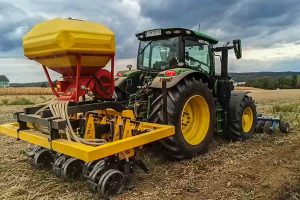
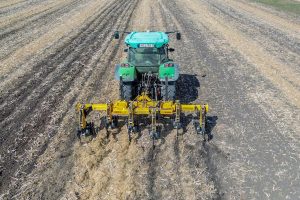
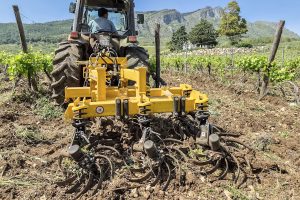
Source of the pictures: https://grekkon.com/ és https://avital.rs/
Prevents surface crusting: A common issue with surface irrigation is soil crusting, which mechanically needs breaking if the soil is prone to it. For instance, the BUSA rotary cultivator is effective in resolving this with minimal energy. Even if moisture eventually reaches the surface with drip irrigation, the soil structure remains intact.
So, how does this tie into BUSA Bt.? It’s about systems. For Hungary’s agriculture to thrive, we need to adopt the best technologies. Precision and digitalization are essential, but I believe large investments in linear irrigation systems that deliver 7 mm of water daily may not be sustainable. This is my motivation.
The story began with a question about subsoiling. Could we design a subsoiler that uniformly loosens soil at 45-50 cm depth? Certainly. But why uniform loosening? Because the contractor’s subsoiler needed it. Could it be aligned with their tool’s spacing and equipped with GPS? Then why not integrate pipe laying with the BUSA subsoiler? So, we built a pipe-laying subsoiler.
I said it very cautiously and carefully, but the geometry of all drip pipe laying subsoilers is wrong. (At least the ones I’ve found.) This is an arrogant statement, but even with regular field subsoilers, people pull “bad” tools around, so I had my suspicions. (This is a very euphemistic way of saying that what is dragged around under the name of subsoilers in Hungary today is at the very least harmful to the soil and should rather be punishable.)
“I’ll spoil the punchline—I wasn’t wrong. The BUSA drip pipe layer is easier to pull and does more sensible work than our alternative.
The machine in the photo is a subsoiler with a special guiding box at the back—not just a pipe holder but a box. There’s a disc harrow upfront reducing drag and handling crop residues. The machine features a load-bearing, spring-loaded roller working only where the blades have passed. There’s also a platform for operators and a pipe reel. Speaking of the reel, I designed an automatic quick-change system, significantly reducing downtime. The difference between a tractor working for 5 minutes and standing idle for 5 or 2 minutes matters. Bonus: the reel tensioner ensures consistent load and tension on the pipe from start to finish.
The machine operates at depths of 35-55 cm and is currently set to 45 cm.
Exciting, isn’t it? It is for me! I’ll surely write more about it. Ask away if you’re curious!