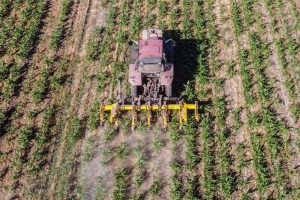
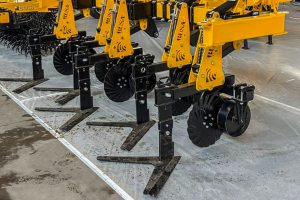
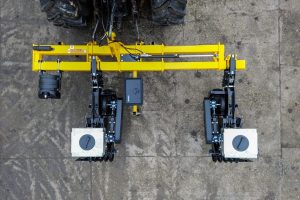
“A year ago we launched the BUSA MPW implement — also known as the ‘Mouse Plow’, our rodent‑control application machine. It was originally intended for field use, in alfalfa and newly sown cereals.
The basic setup is that we pull two units, spaced roughly 2 to 2.5 meters apart. Depending on soil conditions, we run the ‘fake tunnels’ either directly in the tractor’s wheel tracks or next to them. Out in the field there isn’t much to complicate this: the tractor itself determines the row spacing between two passes, and we usually repeat at 10, 15 or 20 meters.
Yes, but vole damage occurs elsewhere too — in orchards and forests — and that’s where it actually makes sense to start varying the setup.
Act Two – Forestry
In newly planted forests, the BUSA Mouse Plow proves extremely useful. Seed‑sown forests adapt better to local conditions and tolerate weather extremes more effectively, but during the first few years they can easily fall victim to voles. The same products are used to address the problem as in arable fields — Arvalin, Ratron, PocokTox.
The challenge was row spacing. In a 2‑meter seedling row, the tractor runs directly above the line, so if we want to place the tunnels close to the young trees, we need an asymmetric setup. It’s not impossible: one unit runs 30 cm to the left of the centerline, while the other runs 1.7 m to the right.
A small inconvenience, though — this configuration is uncomfortably oversized for road transport. So the solution was to retract the right‑hand unit. Voilà: the single‑sided telescopic BUSA Mouse Plow.
Act Three – Orchard
As it turns out, common voles can cause significant damage in orchards as well. What makes orchards special is the highly uneven distribution of burrows: in the tree row, where soil is loosened by under‑row cultivation, there are far more tunnels than in the grassy inter‑row, which is often compacted by traffic. Naturally, voles prefer digging where it’s easier — but not at any cost.
So in this case, we want to place the bait 50–75 cm from the trees, which, with a 5‑meter row spacing, means a working width of about 3.5 to 4 meters. A machine that wide is far from ideal for road transport or for turning at the end of the rows, so here we use telescopic arms on both sides.
This is where we are at the moment, but we already have plenty of new ideas 😉
If you’re dealing with field vole problems, feel free to contact us!